I’m Recovering……

Not from the flu, bladder infection or some illegal drug. I’m recovering just from a cold. A miserable, long-lasting, appetite suppressing, mulit-tissued cold.

I’ve went to great lengths to make sure I didn’t re-infect myself or others: changing my toothbrush, taking Zinc Cold Therapy, drinking Gypsy Cold Care, changing the sheets and sleeping alone. And though I’m a vegetarian, I breathed over a cup of hot chicken soup because it’s been shown to help a cold: https://www.sharecare.com/health/cold-and-flu/why-chicken-soup-have-cold.

Plus I’ve stayed in my house so long I wanted to pull out my hair!

But on day 10 of my cold, I went to the doctor. My doctor’s practice offers Sick Call, a time you can just walk in and it’s only in the mornings. So I went, saw the doctor and got an inhaler to clear my cough and a cough medicine with codeine so I could sleep.

I finally feel so much better I’m sorry I didn’t go to the doctor earlier. But the best part is he said I’m not contagious!

Finally recovering, I can happily say I can now leave my domicile!

Moo-Cow

My son has stopped breastfeeding. My vivacious, smiley, loves all-the-food-in-the-world 12 month old has suddenly decided he does not want to get his milk directly from me. You can tell because of the real tears (real tears, seriously?!) on his face, crying like I’m torturing him as he turns his head away from me over and over again.

My relationship with breastfeeding is complicated and I have to say I’m more than a little surprised to be sad at its end. But here I am, 12 months and 15 days (who’s counting) since this little boy was born, feeling a little panicked that I can’t exactly remember what the moment was like the last time he did feed (yes the app tells me it was yesterday morning at 6:58 am for 4 minutes but what did it feel like??). Was that really the last time? Did I enjoy it enough? Did I read on my phone too much? Did I cherish and honor our special relationship? Don’t I hate words like cherish and honor?? And yet it feels like an important ending to our relationship and while even early on I sort of resented being a glorified moo-cow, somehow, I’m a bit melancholy at losing the role. I secretly thought I’d never even make it to 3 months, or if I was lucky, 6 months, it was just so hard at first.

Weeks and weeks and weeks of very little milk, painful feedings, pumping 6, 7, 8 times a day and night and still having to (sigh) supplement with formula, every 2 hours going through a 45 minute ritual of feed-pump-bottle repeat, over and over again, it was all just so much at first. All the while I mourned the continued loss of autonomy, of freedom, that after nearly 10 months of pregnancy, I could still not drink a beer without feeling guilty.

But then it got better. And we got better. And I wasn’t just a glorified moo-cow, I was a mother. And I fed my child and I played with my child and I danced with my child and I laughed with him and I have watched him grow into a pretty hilarious, fantastic human being so far. I am more than just a source of nutrition for this little baby, something that has been a much murkier issue for me than I realized. So thanks kid, I’m gonna grab a cold one, or three, and cheers your entrance into toddlerhood, the moo-cow is going to pasture.
———————————————————————————————–
Kelly Powers-Hamp is remembering how to be a human being after a year of figuring out this new role of motherhood. A native Chicagoan, she is a working legal professional, devoted wife and friend, as well as a fierce mother to a one-year-old with no sense of self-preservation and endless curiosity. She is much more than breakfast for the baby.

How to Start a Short Story

First, start in the middle of the story. Provide your characters with responses, feelings and thoughts. Make your characters active, not passive- meaning they do things, have actions, not just talk or think.You also need to provide specific details that mean something in the story. Lastly, but most important what does your character want? Need?

Fear is a great place to start a story. A character who is genuinely terrified is the best place because the reader is going to be terrified as well.

Sex is also a good way to begin a story. But who are they? Where is this taking place? On an airplane? On a roller coaster? In bed? On the floor? And what does sex mean to them?

If you’re having trouble starting your short story, use writing practice. Writing practice is a way to get to your unconscious, the place where your creativity lives. If you don’t know how to practice writing practice it goes like this:

Put the arm you don’t use to write behind your back. This is your editor arm. Next put a pen or pencil in your writing hand and begin to write never stopping to edit. Editing kills creativity and you certainly don’t want that.

———————————————————————————————–
Sue Powers has had many stories published. Her favorites are Saturday Evening Post, New Millennium Writings, Blue Earth Review, Adanna, Funny in Five Hundred and Another Chicago Magazine. She is now teaching Writing the Short Story via email.

How to Write a Scene

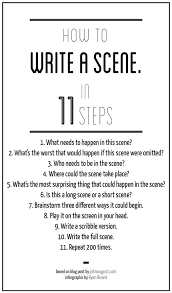
First, start in the middle of the story. Then use conversation that moves the story forward. Also, provide details the mean something in the story and move the story forward. Or provide details about a character, or in this case, about the J’s house and their children.

It’s good to keep the narrative limited and to provide details about characters, such as I did with J’s son and daughter in my story We’re Not Them.

Here’s an example from that story:

The J’s curly-headed son began to plead, clasping his grubby hands together as if praying; their twelve-year-old daughter, glued to her phone, barely looked up, ensuring her heavily mascaraed eyes did not betray her.

“You guys go, we’re frankly beat,” said Jill and drew a hand through her short blond bob. She looked tired, deep circles under her large hazel eyes.

John nodded. He looked refreshed, his thick hair still arranged just so, his dark, hooded eyes bright and clear.

Elizabeth watched as he sat back and lit a cigar. “Disappointing,” Elizabeth said as the son slogged away unhappily to his room. She imagined his room was as messy as the J’s house, cluttered with papers, shoes, books, computers and cords.
—————————————————————————————————
Sue Powers is now teaching How to Write a Short Story via email. Two of her students have health issues, one dropped out and fourth came to the last class. One of the her students who has health issues is now in the hospital. She says she’ll keep me posted when she’ll come out, and Sue hope she does.

How to Write from Felt Experience

“When someone finds just the right words to express their deeper felt sense, there is a feeling of connection, rightness and truth. Gendlin calls this the forward movement of a felt sense and believes that this is the basis of what works in psychotherapy. This is the moment of felt meaning.”

I’ve read those words over and over and it doesn’t explain what felt experience is to my satisfaction. It really is hard to explain. But I can give you an example:

Once I had a friend who whenever I began to describe a book would turn his face away. So I wrote a flash fiction as follows:

The Stutterer
Four men tell jokes. Three are good tellers of jokes, the fourth one is not. He stutters and often doesn’t tell the right punch line. When the stutterer is telling a joke, two of his friends turn their heads away, embarrassed. The third friend does not. He waits patiently, full of heart.

In this flash fiction, I knocked the word embarrassment around until the fiction ended with “full of heart.” It felt to me that it couldn’t end badly, so I ended it with a positive ending.

—————————————————————————————————
Sue Powers has had many stories and flash fictions published over the years. One was published in Saturday Evening Post. On Wednesday evenings she’s now teaching Writing the Short Story via email.

My Creative Writing Class

My ‘Writing the Short Story’ class began two weeks ago. We had four people for the first class. Second class we had three (very nice people). For the third class, the fourth person has said she will be there. But here’s the thing – they’re all beginners.

Beginners need all kinds of help and instructions. How to write a scene, what felt experience is, how tone affects your story, how to read a story from the writers’ point of view, how to develop your characters, point of view, how to publish once you learn the craft of, etc.

I admit it took me years of writing to learn the craft of writing. And here I have only six weeks to teach my beginners just the basics.

For the first class, they learned how to reach their “wild” mind, i.e. the unconscious mind that writes the first draft. Then we went over the arc of the short story. After that we brainstormed ideas for a story they would write. In addition, I asked for them to let me know what they expected to write. One woman took a course in the novel, but she was determined to learn how to write the short story.

The second class we read their stories out loud. It’s important for some one other than the writer to read the story so the writer can hear how it flows. Which is exactly what we did. According the class, that story was done. I didn’t exactly agree with the class. But I feel my job is to encourage a potential writer so I didn’t comment. But further on in this class, I definitely will.

The following class hasn’t happened yet. But I have planned to discuss what felt experience is. That, plus we’ll read the stories I suggested by giving them an idea I’ve used before that was successful.

For many years I taught this course at Glenbrook High School. Then one student wanted a formula for success. There is NO formula for success, and if there is, please share!

People are very busy these days, and the short story has regained interest. After all, one can read a short story in one sitting.

Do you have an interest in writing? Specifically, do you have an interest in writing the short story? Take a class. Join a writing group. Lastly, start writing!
————————————————————————————————–
Sue Powers has 21 fictions published. She’s been awarded a Fellowship and grant in Prose from the Illinois Art Council, and two of her stories were nominated for a Pushcart Prize.

Why I Don’t Have a Job ‘Temporarily’

I drove up to Highland Park to Hair For You for a wig. Yes, I buy wigs because I hate my hair. It’s curly and fizzy and I can’t do anything with it. So I buy wigs.

Anyway, I went to Hair For You and she picked out an extension that I liked. Then styled it and as I was paying for it, she asked me how well I did at research. I said I could do that very well.

So she hired me to research all the wig shops across the country. When I was done with that, I was supposed to research all the beauty schools across the country. I started on the beauty schools, and then I was told they were running out of money.

I wrote an email to the owner and told her I would lower my hourly fee. Also I suggested if I bought a full wig I could pay if off with the work I was doing.

She finally answered and said the project was out of money and that I’d done a good job but would I please temporarily stop working on it.

I call her and left a message. What does temporarily mean? One month, two months, five months?

I’m now waiting for her to call me back. But will she?

In the meantime I started once again looking for a part-time job. If you know of anyone who has a part-time job, let me know.

William Faulkner Fiction Contest or Not

Just recently, my story Eleven Jewish Korean Vets, was published by Saturday Evening Post. Then tonight, I got a call from the William Faulkner Contest judge. She told me I won 2nd prize in the contest, which would have paid a huge amount more than the Saturday Evening Post provided ($25.00). But as my daughter Carrie has said, (I’m paraphrasing) two publications thought my story was worth publishing.

I was quite surprised to get this call. I started pacing which is what I do when I’m trying to think, then I sent out emails to some friends and family and posted it on Facebook. But then I remembered. Once you write a story and send it out, you never know who will take it and who will not. So I can only blame myself for signing the Post contract that says I can’t re-submit for the next six months. Not that the Wm. Faulkner would have been published six months from now. Still, if it’s such a good story that two publications wanted it, I could have found a small press magazine that takes reprints and sent it out. Oh well……

Tomorrow I meet a friend and then next day after that I meet another friend. In between I write and work.

Bottom line, today’s call is now in the past. I’m looking forward to tomorrow. I’ll be updating a story I recently wrote. Fingers crossed I can send it out once it’s updated.
———————————————————————————————————
Sue Powers has 21 fictions published. She’s still working on her book of linked stories, A Surprising Measure of Subliminal Sadness. You can find her teaching Writing the Short Story at John Hershey high school on Wednesday nights, room 119, from 7 to 9 p.m.

Saturday Evening Post Results

Having an active imagination, I expected a great deal more then I received. I expected a publisher or an agent to contact me. And of course that never happened.

But before I discuss what didn’t happen, there were some good things. So far (I can’t speak for the future), Janet Krole, Richard Shandross and Bob McGowan Jr. commented. Mr. McGowan also went into some detail on why he liked it. Also many people emailed me and told me they loved it, liked it, enjoyed it, etc.

As for my writing group, they said didn’t know that Saturday Evening Post was still around. Or to be more exact, another writer smiled at me and another congratulated me prior to the meeting.

Now for the things that didn’t happen. They asked for a photo and a bio, which they didn’t use. Also they paid me $25.00. For a such a prominent magazine, one would think the payment should have been a lot more. (Usually small press magazines pay nothing. It’s supposed to be an honor to be published by a small press magazine, which is supposed to be one’s ‘payment.’)

I spent many hours and quite a bit of energy writing and rewriting until Eleven Jewish Korean Vets (http://www.saturdayeveningpost.com/) was finalized. Now, divide $25.00 by say 60 hours of writing, I just earned .42 cents!

This story went through several drafts before the final draft. My poor writing group spent countless hours reading and critiquing each draft. Then I had it proof-read. I also spent many hours submitting to various publishers, only to get rejections. Finally the Saturday Evening Post accepted this particular story.

But the biggest news is the editor of the Saturday Evening Post has requested another story. Though I doubt much will happen even if I submit and they accept another story.

So…. should I submit to them again and make another .42 cents?
—————————————————————————————————-
Sue Powers is a writer and teacher. She gave up learning how to play the guitar to concentrate on her book of linked stories, A Surprising Measure of Subliminal Sadness.

She’s teaching Writing the Short Story at John Hershey High School, 7-9 p.m., in room 119. You can also follow her blog sj-powers.com and on Facebook: s-j power stories.

A Box of Bad Writing

Guest Blog Post by Pat Childers

I found a large box in my garage marked “bad writing.” I didn’t open it; I just threw it away.

I remember that bad writing. I had begun my self-education in becoming a writer and, with the help of a friend equally blessed with writing ignorance, had begun a novel involving women pirates off the coast of South Carolina in the 1700s. We estimated it would take us about three months to write a 100,000+ word book. We never made it past the first chapter.

What made it remarkable, in my memory, was the total lack of respect we had for the art of writing. We assumed we knew how to type, therefore it couldn’t be that difficult to string together a few words and pound out an historical romance novel. Without the benefit of research, story structure, character development or theme. I did look up the parts of the ship, though. This was 40 years ago, so please don’t judge me too harshly.

Just as an Olympic diver has spent years practicing dives, and a pianist has spent a lifetime honing her craft, a person who writes (not a writer yet) must understand it takes a couple of very large boxes of bad writing to master the rhythm of a well-written page.

It is humbling to arrange the words in such a way that they invoke a sigh from the reader. Or that a character has taken a seat in your mind, and even when you aren’t reading the story, you wonder what they’re doing and if they will make it out okay. The reader doesn’t notice that the sentences have become short and tight as the action builds. The verbs are intense, the adjectives sparse. The reader’s breath comes quicker. The end is near. The story is done.

And the reader sits for a moment, still, gazing out the window and wondering what will happen to Max or Diane now that the story is over. Sometimes, the reader can’t continue on as before, so they turn to page one, and begin again.

If this ever happens to you, it takes a lot of bad writing to become a really good writer.

——————————————————————————————-
Patricia Childers is an artist and writer, and the owner of My Blue Horse Publishing Co. She works with aspiring authors in editorial development, line editing, copy editing, and proofreading to independently publish their novels, or present their finished works to agents and publishers. Contact her at pat@MyBlueHorse.com.