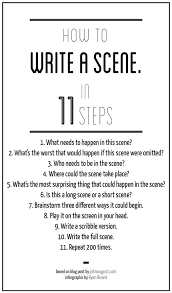
How to Write a Scene

First, start in the middle of the story. Then use conversation that moves the story forward. Also, provide details the mean something in the story and move the story forward. Or provide details about a character, or in this case, about the J’s house and their children.

It’s good to keep the narrative limited and to provide details about characters, such as I did with J’s son and daughter in my story We’re Not Them.

Here’s an example from that story:

The J’s curly-headed son began to plead, clasping his grubby hands together as if praying; their twelve-year-old daughter, glued to her phone, barely looked up, ensuring her heavily mascaraed eyes did not betray her.

“You guys go, we’re frankly beat,” said Jill and drew a hand through her short blond bob. She looked tired, deep circles under her large hazel eyes.

John nodded. He looked refreshed, his thick hair still arranged just so, his dark, hooded eyes bright and clear.

Elizabeth watched as he sat back and lit a cigar. “Disappointing,” Elizabeth said as the son slogged away unhappily to his room. She imagined his room was as messy as the J’s house, cluttered with papers, shoes, books, computers and cords.
—————————————————————————————————
Sue Powers is now teaching How to Write a Short Story via email. Two of her students have health issues, one dropped out and fourth came to the last class. One of the her students who has health issues is now in the hospital. She says she’ll keep me posted when she’ll come out, and Sue hope she does.

How to Write from Felt Experience

“When someone finds just the right words to express their deeper felt sense, there is a feeling of connection, rightness and truth. Gendlin calls this the forward movement of a felt sense and believes that this is the basis of what works in psychotherapy. This is the moment of felt meaning.”

I’ve read those words over and over and it doesn’t explain what felt experience is to my satisfaction. It really is hard to explain. But I can give you an example:

Once I had a friend who whenever I began to describe a book would turn his face away. So I wrote a flash fiction as follows:

The Stutterer
Four men tell jokes. Three are good tellers of jokes, the fourth one is not. He stutters and often doesn’t tell the right punch line. When the stutterer is telling a joke, two of his friends turn their heads away, embarrassed. The third friend does not. He waits patiently, full of heart.

In this flash fiction, I knocked the word embarrassment around until the fiction ended with “full of heart.” It felt to me that it couldn’t end badly, so I ended it with a positive ending.

—————————————————————————————————
Sue Powers has had many stories and flash fictions published over the years. One was published in Saturday Evening Post. On Wednesday evenings she’s now teaching Writing the Short Story via email.

My Creative Writing Class

My ‘Writing the Short Story’ class began two weeks ago. We had four people for the first class. Second class we had three (very nice people). For the third class, the fourth person has said she will be there. But here’s the thing – they’re all beginners.

Beginners need all kinds of help and instructions. How to write a scene, what felt experience is, how tone affects your story, how to read a story from the writers’ point of view, how to develop your characters, point of view, how to publish once you learn the craft of, etc.

I admit it took me years of writing to learn the craft of writing. And here I have only six weeks to teach my beginners just the basics.

For the first class, they learned how to reach their “wild” mind, i.e. the unconscious mind that writes the first draft. Then we went over the arc of the short story. After that we brainstormed ideas for a story they would write. In addition, I asked for them to let me know what they expected to write. One woman took a course in the novel, but she was determined to learn how to write the short story.

The second class we read their stories out loud. It’s important for some one other than the writer to read the story so the writer can hear how it flows. Which is exactly what we did. According the class, that story was done. I didn’t exactly agree with the class. But I feel my job is to encourage a potential writer so I didn’t comment. But further on in this class, I definitely will.

The following class hasn’t happened yet. But I have planned to discuss what felt experience is. That, plus we’ll read the stories I suggested by giving them an idea I’ve used before that was successful.

For many years I taught this course at Glenbrook High School. Then one student wanted a formula for success. There is NO formula for success, and if there is, please share!

People are very busy these days, and the short story has regained interest. After all, one can read a short story in one sitting.

Do you have an interest in writing? Specifically, do you have an interest in writing the short story? Take a class. Join a writing group. Lastly, start writing!
————————————————————————————————–
Sue Powers has 21 fictions published. She’s been awarded a Fellowship and grant in Prose from the Illinois Art Council, and two of her stories were nominated for a Pushcart Prize.

Why I Don’t Have a Job ‘Temporarily’

I drove up to Highland Park to Hair For You for a wig. Yes, I buy wigs because I hate my hair. It’s curly and fizzy and I can’t do anything with it. So I buy wigs.

Anyway, I went to Hair For You and she picked out an extension that I liked. Then styled it and as I was paying for it, she asked me how well I did at research. I said I could do that very well.

So she hired me to research all the wig shops across the country. When I was done with that, I was supposed to research all the beauty schools across the country. I started on the beauty schools, and then I was told they were running out of money.

I wrote an email to the owner and told her I would lower my hourly fee. Also I suggested if I bought a full wig I could pay if off with the work I was doing.

She finally answered and said the project was out of money and that I’d done a good job but would I please temporarily stop working on it.

I call her and left a message. What does temporarily mean? One month, two months, five months?

I’m now waiting for her to call me back. But will she?

In the meantime I started once again looking for a part-time job. If you know of anyone who has a part-time job, let me know.

William Faulkner Fiction Contest or Not

Just recently, my story Eleven Jewish Korean Vets, was published by Saturday Evening Post. Then tonight, I got a call from the William Faulkner Contest judge. She told me I won 2nd prize in the contest, which would have paid a huge amount more than the Saturday Evening Post provided ($25.00). But as my daughter Carrie has said, (I’m paraphrasing) two publications thought my story was worth publishing.

I was quite surprised to get this call. I started pacing which is what I do when I’m trying to think, then I sent out emails to some friends and family and posted it on Facebook. But then I remembered. Once you write a story and send it out, you never know who will take it and who will not. So I can only blame myself for signing the Post contract that says I can’t re-submit for the next six months. Not that the Wm. Faulkner would have been published six months from now. Still, if it’s such a good story that two publications wanted it, I could have found a small press magazine that takes reprints and sent it out. Oh well……

Tomorrow I meet a friend and then next day after that I meet another friend. In between I write and work.

Bottom line, today’s call is now in the past. I’m looking forward to tomorrow. I’ll be updating a story I recently wrote. Fingers crossed I can send it out once it’s updated.
———————————————————————————————————
Sue Powers has 21 fictions published. She’s still working on her book of linked stories, A Surprising Measure of Subliminal Sadness. You can find her teaching Writing the Short Story at John Hershey high school on Wednesday nights, room 119, from 7 to 9 p.m.

Saturday Evening Post Results

Having an active imagination, I expected a great deal more then I received. I expected a publisher or an agent to contact me. And of course that never happened.

But before I discuss what didn’t happen, there were some good things. So far (I can’t speak for the future), Janet Krole, Richard Shandross and Bob McGowan Jr. commented. Mr. McGowan also went into some detail on why he liked it. Also many people emailed me and told me they loved it, liked it, enjoyed it, etc.

As for my writing group, they said didn’t know that Saturday Evening Post was still around. Or to be more exact, another writer smiled at me and another congratulated me prior to the meeting.

Now for the things that didn’t happen. They asked for a photo and a bio, which they didn’t use. Also they paid me $25.00. For a such a prominent magazine, one would think the payment should have been a lot more. (Usually small press magazines pay nothing. It’s supposed to be an honor to be published by a small press magazine, which is supposed to be one’s ‘payment.’)

I spent many hours and quite a bit of energy writing and rewriting until Eleven Jewish Korean Vets (http://www.saturdayeveningpost.com/) was finalized. Now, divide $25.00 by say 60 hours of writing, I just earned .42 cents!

This story went through several drafts before the final draft. My poor writing group spent countless hours reading and critiquing each draft. Then I had it proof-read. I also spent many hours submitting to various publishers, only to get rejections. Finally the Saturday Evening Post accepted this particular story.

But the biggest news is the editor of the Saturday Evening Post has requested another story. Though I doubt much will happen even if I submit and they accept another story.

So…. should I submit to them again and make another .42 cents?
—————————————————————————————————-
Sue Powers is a writer and teacher. She gave up learning how to play the guitar to concentrate on her book of linked stories, A Surprising Measure of Subliminal Sadness.

She’s teaching Writing the Short Story at John Hershey High School, 7-9 p.m., in room 119. You can also follow her blog sj-powers.com and on Facebook: s-j power stories.

A Box of Bad Writing

Guest Blog Post by Pat Childers

I found a large box in my garage marked “bad writing.” I didn’t open it; I just threw it away.

I remember that bad writing. I had begun my self-education in becoming a writer and, with the help of a friend equally blessed with writing ignorance, had begun a novel involving women pirates off the coast of South Carolina in the 1700s. We estimated it would take us about three months to write a 100,000+ word book. We never made it past the first chapter.

What made it remarkable, in my memory, was the total lack of respect we had for the art of writing. We assumed we knew how to type, therefore it couldn’t be that difficult to string together a few words and pound out an historical romance novel. Without the benefit of research, story structure, character development or theme. I did look up the parts of the ship, though. This was 40 years ago, so please don’t judge me too harshly.

Just as an Olympic diver has spent years practicing dives, and a pianist has spent a lifetime honing her craft, a person who writes (not a writer yet) must understand it takes a couple of very large boxes of bad writing to master the rhythm of a well-written page.

It is humbling to arrange the words in such a way that they invoke a sigh from the reader. Or that a character has taken a seat in your mind, and even when you aren’t reading the story, you wonder what they’re doing and if they will make it out okay. The reader doesn’t notice that the sentences have become short and tight as the action builds. The verbs are intense, the adjectives sparse. The reader’s breath comes quicker. The end is near. The story is done.

And the reader sits for a moment, still, gazing out the window and wondering what will happen to Max or Diane now that the story is over. Sometimes, the reader can’t continue on as before, so they turn to page one, and begin again.

If this ever happens to you, it takes a lot of bad writing to become a really good writer.

——————————————————————————————-
Patricia Childers is an artist and writer, and the owner of My Blue Horse Publishing Co. She works with aspiring authors in editorial development, line editing, copy editing, and proofreading to independently publish their novels, or present their finished works to agents and publishers. Contact her at pat@MyBlueHorse.com.

Marketing and Writing

How much time do you spend writing vs marketing? I would imagine it depends on what you are writing. Say you’re writing a novel, a non-fiction book or a mystery. It takes a considerable amount of time to write these. But if you’re writing short stories, it takes much less time, so you can do more ‘marketing’ (I.e. getting your stories published.)

Short stories are different from full-length manuscripts. First, you don’t need an agent. Second, the first step is to get the story published. Lastly, once you’ve completed your book, then you can start marketing it.

In the days before Internet, writers would get fan mail in the post, actual physical letters, (some still do) and they would answer those letters. There are some great pictures of Hemingway standing up at his typewriter answering his letters every afternoon.

When people would do interviews, they would go on physical tours, to bookstores, or to fairs or different venues. Charles Dickens used to go around speaking. I believe people still go on physical tours to market their book.

Try and think of how you can integrate marketing in a sustainable way for you that’s creative and also meets the goals of what you want for your writing. Do you want to sell more books? Or do you want to become famous? It’s rare for an author to be come famous. So set your goal to sell more books. (By the way, I once had a student who wanted a formula to become famous author!)

Publishers rarely market their books other than putting them on their website. So it’s up to the author to market her book. The exception is Windy City Publishers. They’re a hybrid publisher that does the marketing for you. Of course they’re rather expensive, but if you are fed up trying to publish your book the traditional way, this may be the way to go.

There are other ways to self-publish. BookBaby is one of them. BookBaby offers print, e-books or print and ebooks. Plus it’s an affordable e-book self-publisher with no sales commission, plus your book gets an ISBN number through them. There’s also Amazon who publishes your book on Kindle.

I’m sure there are other self-publishing companies. Investigate and get back to me.

My Addicition

It’s not alcohol, cigarettes, heroin or any other illegal drug…. it’s word games!

One game is Lexulous – a Facebook word game. I love this game and each morning I play it. Lexulous, which is similar to Scrabble, offers two dictionaries. One is the US dictionary; the other is the UK dictionary. The UK dictionary offers many more two-letter words such as CH, KY, NY, FY, plus longer words that aren’t in the US dictionary. Plus, you’re allowed to use the dictionary while you’re playing.

I find it are hard to play Wordcrasher and Words with Friends (both are FB games) on my phone so I play these on my computer. Words with Friends also has a dictionary you use – but I find it’s US dictionary limiting.

Some who play Words with Friends find it more challenging. Maybe because I’ve played Lexulous longer and it has the UK dictionary that I obviously enjoy. When I play Words with Friends its fun but not very challenging. Plus there are words one can use in Lexulous that aren’t not in Words with Friends. However, more people play Words with Friends than Lexulous, meaning of course it’s more popular.

Let me now add Soltaire. I’ve become addicted to Soltaire. I’ve won (I think it’s rigged) many times and for some reason I’m addicted to it.

There are other games such as the card games Monopoly Deal, Karma and the word game Quiddler that I enjoy.

If you love word games, let’s play together. But watch out – you could become addicted!

Writing Tips: Find Inspiration through the Environment

If you are struggling to get words onto the blank page, don’t just sit there. Fill your creative well.

Here are some ways to do that:

1. The Music of Your Environment
This is how I turn the sounds of the world around me into fodder for inspiration. While you’re out for a walk, running errands, or just taking care of business, take a moment to truly listen to your environment.

If you’re driving to a specific destination, focus all your senses on the road and the traffic around you.

If you have a smart phone, tablet, or digital voice recorder, take down your thoughts for later use. You can also do this while sitting on your porch, after a long day at work, or running around with your family.

2. Inspiration through Music
If you’re in the middle of a scene and you can’t come up with just the right element to keep your story moving forward, here’s a tip that might help you focus on your work.

Turn on your favorite radio station or your writing playlist. Let the music resonate through your entire body and let your mind wander where the music takes you.

What ideas come to mind as you listen?

After the song or piece of music is over, pick up your mobile device, notepad and pen, or open a blank document in your word processor of choice, and jot down the tidbits that come to you. You may not be able to use them at the moment, but keep them for later use.

Even though you are a writer, do you also play a musical instrument? If you already have an instrument that you play, I have a suggestion for you. Why not sit down at your instrument, or pick it up and play whatever is in your heart.

Making your own music is just as powerful and inspirational, if not more so, than listening to recorded music, or attending a live concert.

3. Read, Read, Read!
I know authors and marketing professionals have discussed this topic on webinars and podcasts, but I want to add my encouragement to all writers, from novices to full-time authors.

You don’t have to rely on print or eBooks only, you can also get audiobooks to listen to as you work. I read a lot of books in my genre, but I also read other books, to find that little nugget of inspiration, when I am suffering from writers’ block.

I’ve heard it said that you can’t be a great writer without being an avid reader first.

4. Find other sources of inspiration
Although I stress the importance of reading to become a better writer, there are other sources of entertainment and information you can use for inspiration.

Many people mention that they become inspired by movies. Although I can agree with that to a certain extent, you don’t have to limit yourself to this medium only. TV shows and movies aren’t the only sources of inspiration I’ve found. If you can find an app or a website that has links to free audio recordings, such as classic radio shows.

Listening to podcasts is another great source of information and inspiration. Also, engaging with like-minded people is beneficial.

5. Here’s a tip that I think all writers can use in their writing process. Find a writers group, or a critique partner or group to help you fine-tune your writing before you get published. The more you can tweak your writing, the more likely others will read it.

Sometimes writers can inspire each other, so connecting through email or social media is a good way to “talk shop” with people who are walking the same writing road as you are.

You and your writing friends can encourage each other on your career path, and your mentors can hold you accountable for a project you are working on, so you can get it finished and into the hands of readers.

I strongly urge you to take advantage of these inspirational sources, because something that a character says or a description of a scene can lead to an idea that you can’t let go of. There are hundreds, possibly thousands of ways to find inspiration, these are a few of the methods that personally work for me.

I hope that you can find one or more of these tips helpful in your own writing.

How do you find inspiration for your creative work? Please leave your thoughts below.
____________________________________________________________________
Sue Powers has a dazzling array of publishing credits. Among her favorites are New Millennium Writings, Another Chicago Magazine, Happy, Facets, The Writer’s Place, Funny in Five Hundred, Blue Lake Review and Samizdada. She has won some writing awards and been nominated for others.

Reminder: She’ll be teaching Writing the Short Story at Hershey High School in Arlington Heights, September 5-October 17th, from 7 pm to 9 pm., Room 1080.
She’ll also be teaching How to Publish Your Manuscript at Morton Grove Library, sometimes in October/November.